
Case study
Plaidoria — sourced legal drafting
A platform I designed, built and operate myself, in production at plaidoria.fr. It drafts structured, sourced legal briefs for lawyers, and every reference is checked against official French government sources.
Guided tour · Plaidoria
From case file to draft brief.
See the workflow and its checks through an example published by Plaidoria. The brief was generated on July 25, 2026, from a fictitious traffic law case.
Read the full public brief (in French) (opens in a new tab)A commented walkthrough of a public example. The diagrams are illustrative; no generation runs during this tour.
Open the steps to examine the workflow.
Prepare the case file
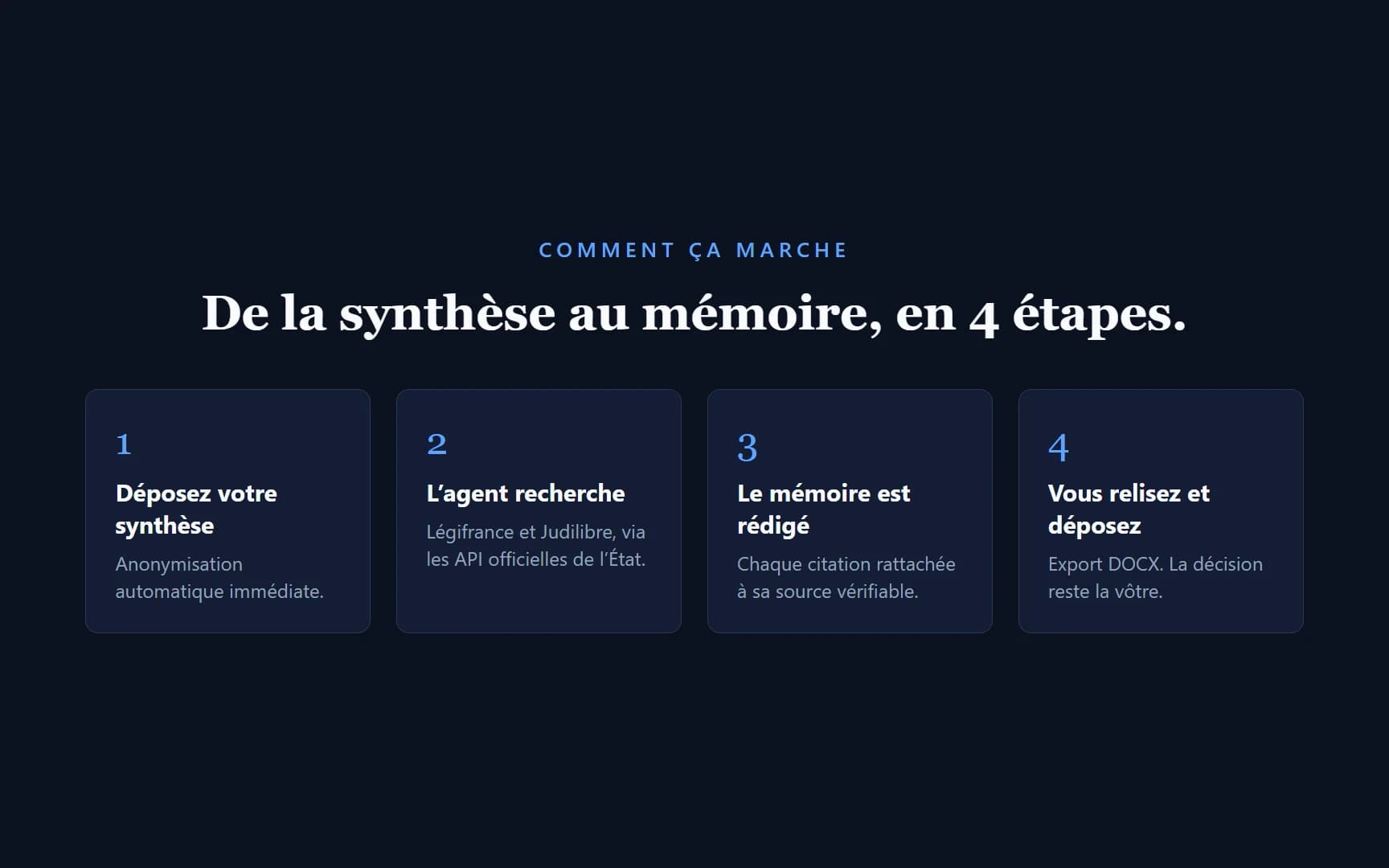
The lawyer provides the case summary and the supporting documents. Before generation, the lawyer reviews the pseudonymized version that will be sent to the model, corrects it if needed, then confirms it.
What to look for
Human review also comes before the AI call. The automatic detection of identifying data must be checked.
Source for this stepWorkflow and data protection (opens in a new tab)
Summary and documents
The context provided by the lawyer
Pseudonymization
Identifying details replaced with tokens
Review and confirmation
The content to be sent checked before generation
The mapping table stays on Plaidoria’s servers.
Find the sources
The system searches the official databases. In the published example, the brief’s references are listed with their links. You can open two of them here on Légifrance, the official French legal database.
What to look for
A reference can be checked separately from the generated text, so the lawyer can go back to the original document.
Source for this stepOverview of the product workflow (opens in a new tab)
- [1]
Regulation
Article R223-3 of the Code de la route (French Highway Code) (opens in a new tab)legifrance.gouv.fr
- [3]
Court decision
Conseil d’État (France’s highest administrative court), November 20, 2024, No. 493806 (opens in a new tab)legifrance.gouv.fr
Links taken from the published document. Their presence does not prejudge the relevance of the argument.
Examine the first draft
The example concerns a challenge to the invalidation of a driver’s license. Its outline separates the facts, the discussion and the requests. The full document remains available so you can judge the result.
What to look for
The structure helps the lawyer pick up the work. It does not validate the legal reasoning.
Source for this stepPublished output example (opens in a new tab)
Traffic law · Fictitious case
Originating application
- I. Facts and procedure
- II. Discussion
- III. For these reasons
“Subject to production of the following documents”
Layout recomposed for this tour; the full text is available on Plaidoria.
Revise and approve
The note in the example flags items to complete. The lawyer checks the documents, the references and the argument. DOCX export then makes it possible to rework the draft.
What to look for
The deliverable remains a first draft. Review, defense choices and the decision to file belong to the lawyer.
Source for this stepNote to the lawyer in the public example (opens in a new tab)
- Check the registered address on the relevant date.
- Obtain proof of notification.
- Complete the documents and confirm the procedural dates.
Summary of the public note, with no added legal advice.
Draft brief → lawyer’s review → reworked document
Understanding the need
The context.
Plaidoria is a product I designed, built and operate myself: a platform in production that drafts legal briefs for French lawyers and legal professionals, starting from a case summary and the supporting documents. It covers seven areas of law: criminal, civil, employment, commercial, immigration and asylum, traffic, and intellectual property.
The problem to solve
Drafting a legal brief takes several hours of research and formatting for each filing, and generic language models cannot be used as they are: one invented reference, a repealed text cited as in force or an outdated deadline is enough to discredit a filing before a court.
The design frame
The constraints.
- Zero tolerance on references: one false citation discredits the filing, and the trust that goes with it
- Case documents covered by legal professional privilege: no identifying personal data may reach a model
- The lawyer remains the sole signatory: the tool produces a draft filing, never legal advice
- Large real-world case files: several hundred pages to process, OCR included
The answer
What was designed.
- A drafting pipeline anchored in official French government sources: statutes and case law are retrieved through API PISTE, the French government’s API gateway (Légifrance, the official French legal database; Judilibre, the French courts’ case-law database), never cited from memory
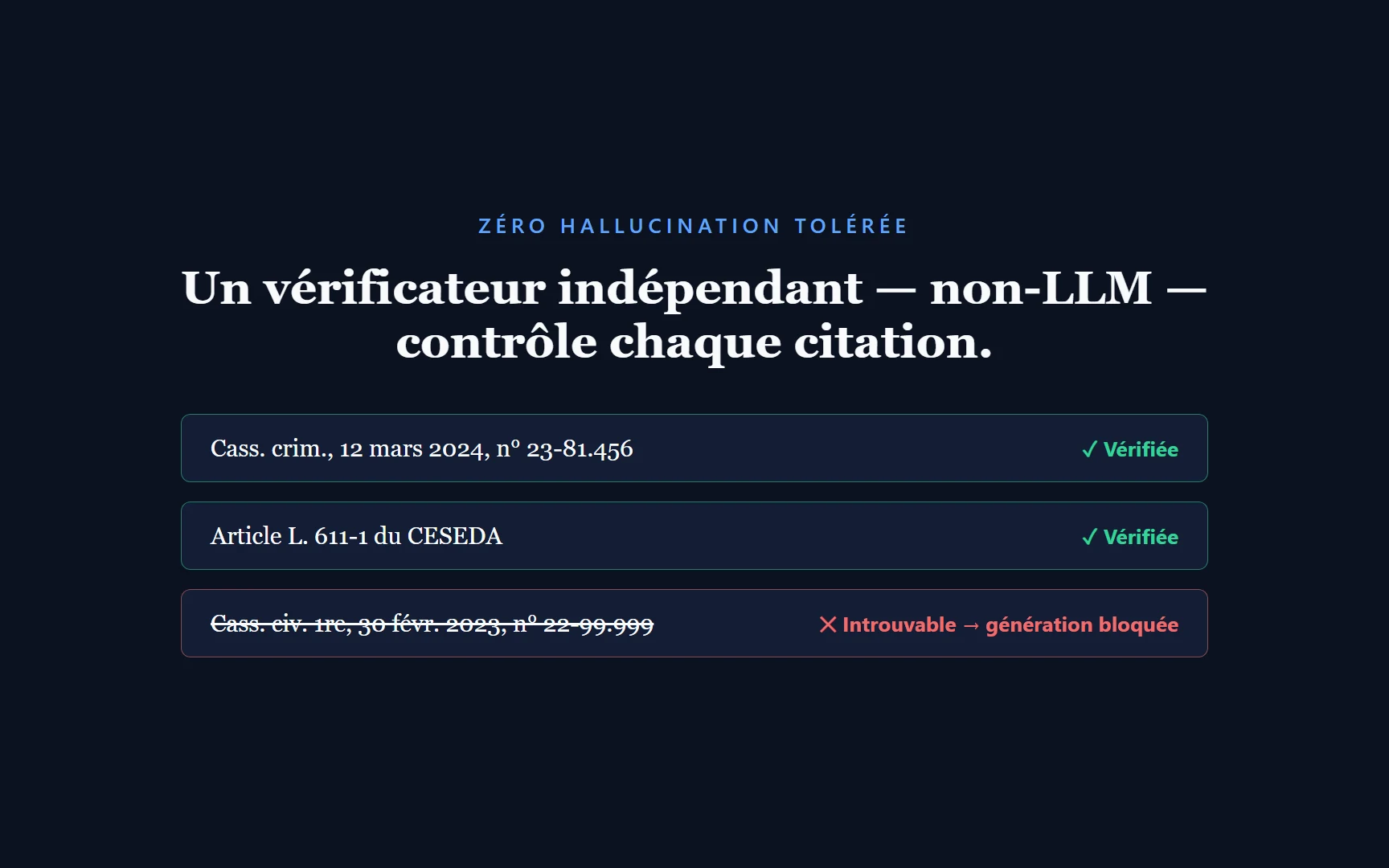
- In-depth anti-hallucination checks: every reference in the brief is verified (existence, version in force, correct code), then an independent reviewer compares the draft with the actual texts
- GDPR compliance by design: case documents pseudonymized before any model call, EU hosting, no training on client data, review and approval by the lawyer required
- A complete product rather than a prototype: multi-user accounts with strong authentication, a research note attached to each brief, DOCX export, and a public offer from a single filing to a law-firm subscription, with online payment
The results
Documented results
A product carried end to end (design, compliance, go-to-market, operations) in a field with zero tolerance for error. Every legal reference is checked against Légifrance and Judilibre, the official French legal and case-law databases. Case documents are pseudonymized before any model call, and the public offer is live with online payment.
- A structured, sourced first draft of a brief, including on case files of several hundred pages
- Estimated gain of several hours of research and drafting per filing, reinvested in analysis and strategy
- A public offer that is live, from a single filing (from €99 excl. VAT) to a law-firm subscription
- A verifiable framework of trust: traceable sources, reference checks, GDPR commitments documented publicly
Know-how in practice
What this proves.
- Ability to carry a product end to end: design, development, compliance, go-to-market and operation in production
- Ability to make generative AI admissible in a field with zero tolerance for error, through systematic checks rather than promises
- Ability to bring confidentiality, professional standards and a business model together in a single system
In depth
Further reading.
Project overview
Plaidoria holds a distinct place in this portfolio: it is not a client engagement but a product I designed, built and operate myself, in production at plaidoria.fr. The platform drafts legal briefs for French lawyers and legal professionals, starting from a case summary and the supporting documents, across seven areas of law: criminal, civil, employment, commercial, immigration and asylum, traffic, and intellectual property.
The founding principle: in litigation, an AI system is only as good as what keeps it from getting things wrong. Statute and case-law research goes exclusively through API PISTE, the French government’s API gateway (Légifrance, the official French legal database, and Judilibre, the French courts’ case-law database); every citation in the brief can be traced back to its official source. The tool produces a draft filing for the lawyer to review. It does not give legal advice and replaces no one.
What the project demonstrates
- Anti-hallucination can be a mechanism, not a promise: every cited reference is verified (existence, version in force, link to the right code), then an independent reviewer checks the brief against the actual texts before it is delivered. A doubtful reference is flagged, never disguised.
- Confidentiality can be structural: case documents are pseudonymized before any model call, hosting is in the European Union, and no client data is used to train anything. GDPR is not a legal page; it is an architectural constraint.
- A vertical AI system can be a complete product: multi-user accounts with strong authentication, a research note attached to every brief, DOCX export, a public offer from a single filing (from €99 excl. VAT) to a law-firm subscription, and working online payment.
- Real case files of several hundred pages, OCR included, can go through the pipeline. Robustness is measured on the files that overflow, not on textbook cases.
Product perspective
Plaidoria embodies the thesis that runs through this site: the value of an AI system does not come from the model but from the control system built around it. Here, that system is sized for a profession where errors cost immediately: checks against the law in force, review against the texts, traceable sources, and the lawyer’s role preserved at every step.
It also demonstrates a rare capability: carrying a product alone from legal scoping to commercial operation, including positioning, compliance, pricing, payment and support for the first users. The generated brief remains a first draft; responsibility, judgment and signature stay with the lawyer. This restraint is not a limitation of the product. It is the case for it.
From this project to your need
A similar need?
Describe your context, the tool involved and the constraints to take into account. We can then define the first useful step.